
Music has been a feature of most cultures for thousands of years, but the earliest examples of written music using musical notation were written in around 1400 BC in modern-day Iraq. Although the notation used was much different to the sheet music we’re used to seeing today, it shows that humans have always been interested in finding ways to represent and preserve music through writing it down.
However, it was in the 11th century that staves with multiple lines were introduced. Guido D’Arezzo, an Italian music theorist, was the first to introduce standard form for all notes and a four-line staff with more lines being added in the 12th and 13th centuries. Thanks to the invention of the printing press in the 15th century, sheet music was then more widely available and allowed more people to learn to read music
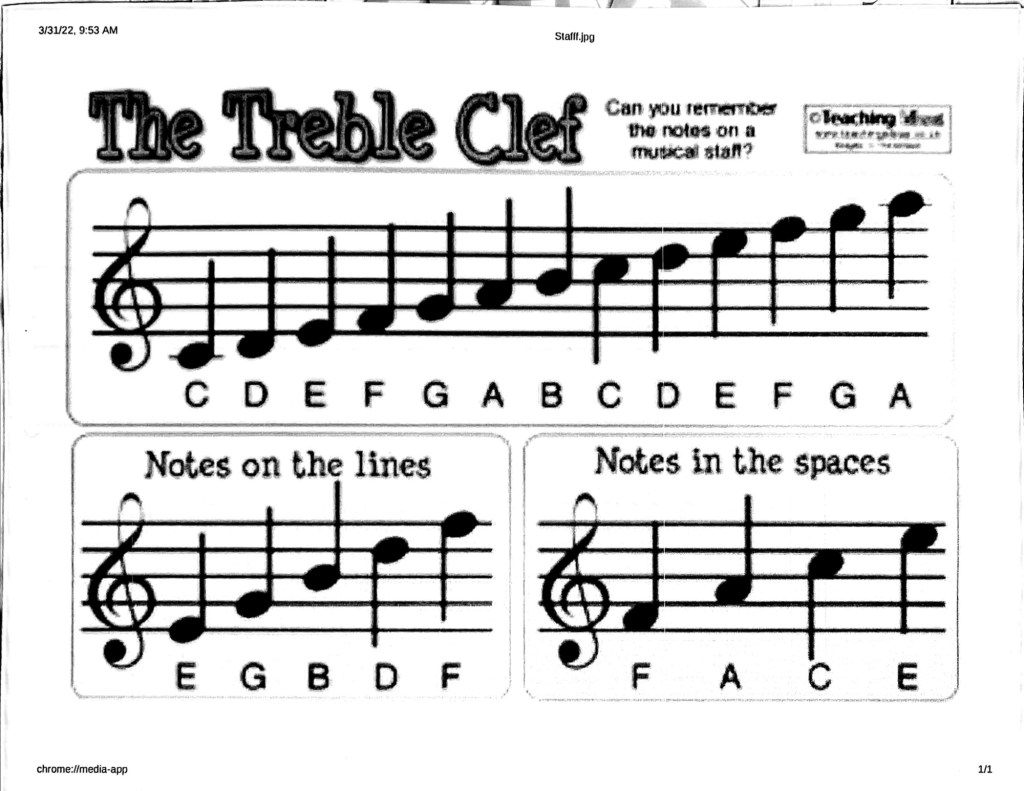
Music notation is written on sets of five lines known as the staff (pl. staves). It can be understood a bit like a graph, with information being given on the horizontal axis and the vertical axis. The horizontal axis tells us about rhythm: how long notes are played for and when. The vertical axis tells us about what pitch the notes we play are. To indicate pitch, notes are placed higher and lower on the staff, and on specific lines spaces. Sometimes notes go higher or lower than the staff. In these cases, ledger lines can be added.
 Perrymuse
You must be logged in to post a comment.